Discovering a cracked tile or noticing one starting to lift can leave homeowners wondering whether it’s a quick fix or a sign of something bigger. The right approach depends on the extent of the damage, the underlying cause, and how the rest of your flooring is holding up. Here’s how to make that call confidently.
Common Causes of Cracked or Lifting Tiles
Impact Damage
A dropped heavy object or significant impact can crack an individual tile without necessarily affecting the surrounding area or the subfloor beneath it.
Subfloor Movement or Instability
Cracking or lifting across multiple tiles often points to underlying subfloor issues — settling, moisture damage, or inadequate initial preparation before installation.
Poor Original Installation
Insufficient adhesive coverage or poor installation techniques can cause tiles to loosen, lift, or crack over time, even under normal foot traffic.
Moisture-Related Issues
Excess moisture beneath tiles, whether from a plumbing leak or inadequate waterproofing, can weaken adhesive bonds and cause tiles to lift.
Temperature and Humidity Fluctuations
Dubai’s heat and humidity fluctuations can cause building materials to expand and contract over time, occasionally affecting tile stability in areas where installation was substandard.
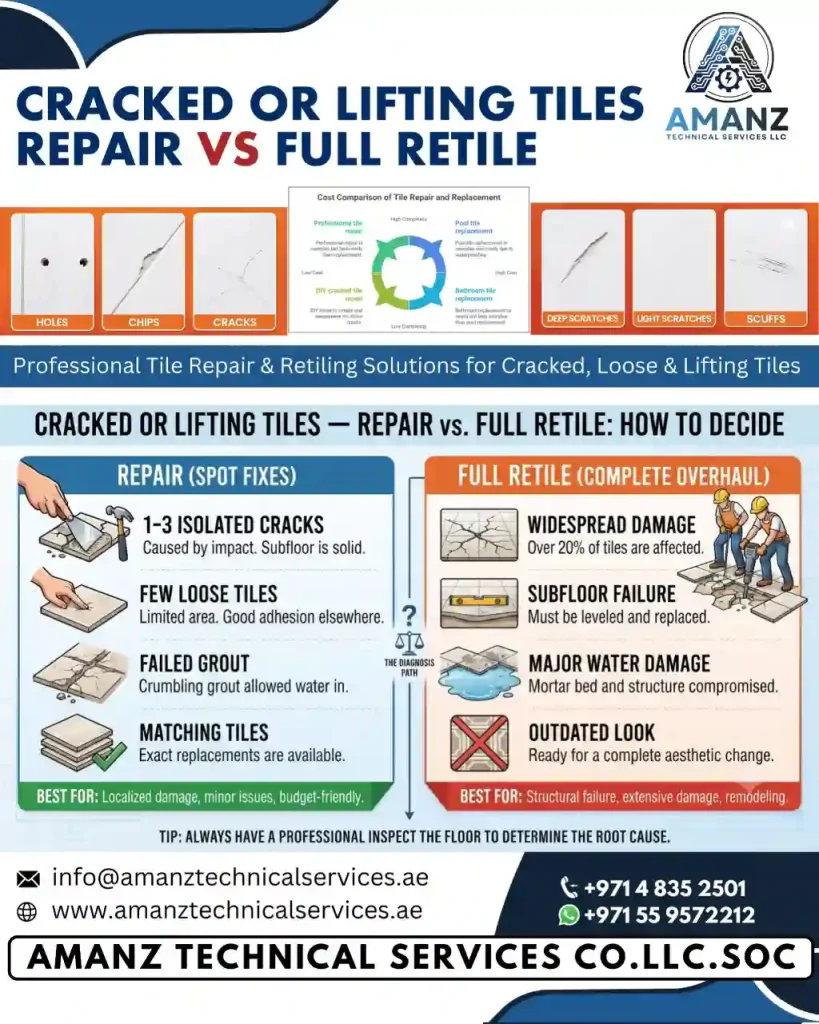
When Repair Is the Right Choice
Isolated, Single-Tile Damage
If only one or two tiles are affected—whether cracked by impact or lifted in a small area—a targeted repair that replaces only those tiles is usually sufficient.
Surrounding Tiles Remain Stable
If the rest of the flooring shows no signs of similar issues, this suggests the problem is localized rather than indicative of a broader subfloor issue.
The Cause Has Been Identified and Resolved
If the damage resulted from a one-time event, such as an impact, rather than an ongoing structural issue, repairing the affected tile is generally the most appropriate solution.
When Full Retiling Makes More Sense
Widespread Cracking or Lifting
If multiple tiles across the room show similar issues, this often points to a systemic problem — such as subfloor instability — that a spot repair won’t resolve.
Underlying Moisture or Structural Issues
If lifting is linked to ongoing moisture problems or subfloor movement, addressing just the visible tiles without resolving the root cause will likely lead to recurring issues.
Significant Age and Wear
For older flooring where tiles are cracking or lifting due to general wear across the installation, a full retile often makes more sense than repeatedly patching individual sections.
Difficulty Matching Existing Tiles
If your existing tiles are discontinued or difficult to match exactly, isolated repairs may result in a visibly inconsistent floor — sometimes making a full retile the more aesthetically sensible choice.
The Repair Process
A typical tile repair involves carefully removing the damaged tile, addressing any underlying subfloor issues if necessary, and installing a replacement tile that matches the surrounding flooring as closely as possible.
The Retiling Process
Full retiling involves removing all existing tiles, addressing any subfloor issues, and installing new tiles throughout the space — a more involved and costly process, but one that comprehensively resolves systemic issues.
Cost Considerations
Repair Costs
Targeted repairs are generally far less expensive, involving only the material and labor for the specific affected area.
Retiling Costs
Full retiling represents a considerably larger investment, covering the entire room’s material and labor, but offers a comprehensive, uniform result and resolves any underlying issues throughout the space.
Getting a Professional Assessment
If you’re uncertain whether your issue is isolated or systemic, a professional assessment can identify the underlying cause — helping you avoid either an insufficient spot repair or an unnecessarily costly full retile.
Conclusion
Deciding between tile repair and full retiling comes down to understanding whether the damage is isolated or symptomatic of a broader issue affecting your flooring. Amanz Technical Service offers Single-tile damage with a clear, resolved cause typically warrants a straightforward repair. Widespread cracking, lifting, or underlying moisture issues often justify the more comprehensive investment of a full retile.